
Abercromby Clan
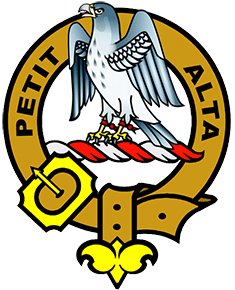
Abercromby/Abercrombie Crest: A hawk, rising, proper, belled, or.
Abercromby/Abercrombie Clan Motto: Petit Alta (He aims at high things).
Abercromby/Abercrombie Clan History: This surname originates from the Barony and Parish of Abercromby in Fife. William de Abercromby (spelled Haberchrumbie), and Johan de Abercromby of the County of Fife, rendered homage to Edward I of England in 1296.
The Abercrombies of that Ilk, the principal family of the name, became extinct in the mid - seventeenth century, and the Abercrombies of Birkenbog, their Banffshire lands granted to them by the Bishop of Aberdeen, took over as representatives of the Name. Certain family members served in the Garde Ecossais in France. Sir Alexander Abercrombie, 1st Baron of Birkenbog, was a made a Commissioner for Banffshire, and his son sat as a Member of the Scottish Parliament in 1694.
The Abercrombies were to begin with deeply committed to the Catholic Church, starting with Robert Abercromby, born in 1534, who became a Jesuit Priest and was fiercely opposed to the Reformation. David Abercromby, a kinsman, having studied abroad, returned to Scotland to oppose the Protestant faith, but was instead converted. Sir Alexander Abercromby of Birkenbog, created a Nova Scotia Baronet in 1637, was a staunch supporter of the Covenanters and opposed the attempts of Charles I to impose the Episcopal religion on Scotland.
Sir Ralph Abercromby (1734-1801) was born at Menstrie and, having served in the Seven Years War against Napoleon as an officer in the Dragoons, became Member of Parliament for Clackmannanshire from 1774 to 1780. In 1797, he commanded the British forces in Ireland. He also saw military action in the West Indies and, having been sent to the Mediterranean in 1801, was mortally wounded in Alexandria. His widow was awarded a peerage, and the title passed to their eldest son. His brother, Sir Robert, commanded the British Forces in India, and was awarded the Order of the Bath. He was later appointed Governor of Edinburgh Castle.
Sir John Abercromby (1772-1817), Sir Ralph's second son, served on his father's staff and was captured and interned by Napoleon in 1803. After his release in 1809, he was appointed a divisional commander in India, and in 1810, led the capture of Mauritius. James Abercromby, 1st Baron Dunfermline, was Sir Ralph's third son. He entered parliament in 1803 and held the office of Speaker from 1835-1839. John Abercrombie (1780-1844) from Aberdeen, moved to Edinburgh and, in 1821, was recognised as the first consulting physician in Scotland.
Places of Interest: The small hamlet of Abercrombie, is situated a mile from St Monans in Fife. Airthrey Castle, Bridge of Allan, nr. Stirling, is a Robert Adam designed castle which was purchased by Sir Robert Abercrombie in 1798. The castle and estate was owned by Abercrombie family until 1889. Airthrey is now incorporated into the campus of the University of Stirling. Birkenbog House, nr Cullen, Banffshire. Built on lands held by the Abercombies since the 14th-century, Birkenbog is an 18th-century house which incorporates part of a much older castle. The house was abandoned by the family in the late 1700's. Craigrownie Castle, Cove, Argyll and Bute. Alexander 'Greek' Thomsom designed Victorian Baronial castle, bought by the Abercrombies in the mid 1800's. Fetternear House, Kemnay, Aberdeenshire. Owned by the Abercrombies of Birkenbog 1627-1690. Forglen House, Turriff, Aberdeenshire. Privately owned castellated mansion house with Gothic mausoleum, built by the Abercombies in the 1800's, incorporating a 16th-century castle. Inchdrewer Castle, Banff, Banffshire. Altered 16th century tower house which passed to the Abercrombie family of Birkenbog in the early 1800's. Menstrie Castle, Menstrie, Clackmannanshire. 16th-century tower house bought by the Abercrombies in 1719.
Dr John Abercrombie, the distinguished physician, lived at 19, York Place, Edinburgh. Nearby is Abercrombie Place, also situated in the New Town of Edinburgh. It was named after Sir Ralph Abercrombie who fell at Aboukir Bay in Alexandria in 1801.
Surname distribution within Scotland: Most instances of the Abercrombie surname occur in Ayrshire, Falkirk and Stirlingshire.
Buy a Clan Abercrombie certificate.