
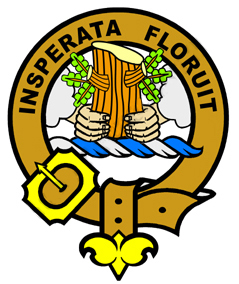
Watson Clan
Watson Clan Crest: Two hands, issuing from clouds, grasping an oak-tree trunk, branches sprouting.
Watson Clan Motto: Insperata Floruit (Flourishing unexpectedly).
Watson Clan History: This surname literally means “Son of Walter” from the surname Watt or Wat. The name Watt, however, is also associated as a Sept of Clan Buchanan.
A John Watson held lands in Edinburgh in 1392, and the name also appears in Aberdeen, Arbroath, Lanark and Dumbarton. The Chiefship is currently dormant, having seemingly ended with James Watson of Saughton in 1818. The Clan Watson Society International is based in Colorado, USA.
George Watson (d.1723) was a merchant in Edinburgh, and the first accountant of the Bank of Scotland. He left money to create a hospital for the maintenance and education of sons and grandsons of “decayed” Edinburgh merchants. James Watson (d.1722) was an Edinburgh-based printer who published the Edinburgh Gazette and the Edinburgh Courrant. Robert Watson (1746-1838) was born in Elgin and fought for American Independence. He was the Emperor Napoleon Bonaparte’s tutor in English, and was President of the Scots College in Paris. James Watt (1736-1819) was born at Greenock, son of a Glasgow merchant, and pioneered and developed the steam engine. The electrical unit of power is named after him. George Watson (1768-1837) was born in Berwickshire, and became a distinguished portrait painter. He was the first President of the Royal Scottish Academy. David Milne-Watson (d.1945) was a Barrister and Industrialist, and was in 1937 created a Baronet, taking the addition of his mother's maiden name of Milne. He was Chief of the Scottish Clan Association of London. Sir Robert Watson-Watt (1892-1973) was born at Brechin and became Scientific Advisor to the Air Ministry in 1940. He played a significant role in the introduction and development of radar. William Watson (1865-1948) became Rector of Inverness Academy, and of the Royal High School, Edinburgh. In 1926, he published Celtic Place Names of Scotland.
Surname distribution: Watson is another name that is widespread throughout Scotland with particularly high concentrations in Aberdeenshire (includes all of the historic counties of Aberdeenshire, Kincardineshire and part of Banffshire), Moray (including most of historic Banffshire), Aberdeen City, Fife, Edinburgh City and the Lothians (Linlithgowshire, Edinburghshire and Haddingtonshire).
Places of Interest: George Watson's College, Edinburgh. First established as a hospital in 1741, it became a school for boys in 1871 and merged with its sister school, George Watson's Ladies College, in 1974. It is maintained by the Edinburgh Merchant Company.