
Stuart Clan
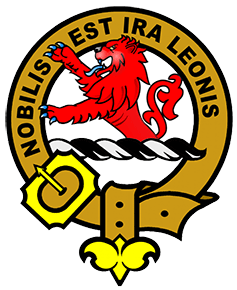
Stuart of Bute Clan Crest: A demi-lion rampant, Gules.
Stuart of Bute Clan Motto: Nobilis Est Ira Leonis (The lion's anger is noble).
Stuart of Bute Clan History: Walter Fitz Alan was among the Norman noblemen who accompanied David I on his return to Scotland, where he was appointed High Steward. Through the strategic marriage of his descendant to Princess Marjory, daughter of Robert the Bruce, the Stewards or Stewarts, as they became, acquired the throne of Scotland on the death of Bruce's only son. Robert II, Bruce's grandson, bestowed the lands of Bute, Arran and Cumbrae on his younger son, John, and created him Hereditary Sheriff of Bute.
Throughout the following centuries, the Stewarts went about their duties. In 1498, Ninian was made Keeper of the Royal Castle of Rothesay, an honour still held by the family. With the passing of years, the spelling of the surname was altered to Stuart, in keeping with that adopted by Mary Queen of Scots on her return to Scotland from France.
Sir James Stuart of Bute was a firm Royalist supporter and was appointed Royal Lieutenant for the West of Scotland. As a result, when Oliver Cromwell's forces prevailed, he fled to Ireland. His estates were broken up, and he was obliged to pay a substantial fine to redeem them. His grandson, Sir James Stuart of Bute, supported the succession of William and Mary and, in the reign of Queen Anne, became a Commissioner for the Act of Union between the Scottish and English parliaments. In this role, he was, in 1703, created Earl of Bute. He later came to the conclusion that the Union was a mistake and consequently withdrew from active politics. This did not, however, prevent him from looking after Government interests In the Bute and Argyll region during the 1715 Jacobite Uprising.
The 3rd Earl of Bute was tutor to George III in his infancy, and was made First Lord of the Treasury. It was he who commissioned the architect Robert Adam to build Luton Hoo in Bedfordshire, his home in England.
The 4th Earl married Charlotte Jane Windsor, heiress to vast estates in South Wales, and in 1796, was made the 1st Marquess of Bute. His grandson, the 2nd Marquess of Bute, wed Elizabeth Penelope Crichton, heiress to the Dumfries Estate. The 2nd Marquess developed the docklands at Cardiff to rival Liverpool. It was so successful that when he died, John, the 3rd Marquess, inherited a vast fortune in his infancy.
The 6th Marquess of Bute was a stalwart of Scottish heritage and, for his work in this field, was rewarded with a knighthood shortly before his death in 1993. The 7th Marquess was better known Johnny Dumfries, the Le Mans winning racing driver. Sadly, he passed away in 2021. His son, John (Jack) Bryson Crichton-Stuart, became the 8th Marquess of Bute, on his fathers death.
Frances “La Belle” Stuart (1647-1702) was a granddaughter of the 1st Lord Blantyre, and a Lady-in-Waiting to Catherine de Braganza, wife of Charles II. She was married to the Duke of Richmond, and modelled for the figure of Boadicea featured on British coinage. Sir Charles Stuart (1753-1801), younger son of the 3rd Earl of Bute, captured Minorca from the Spaniards. His son, also Sir Charles (1779-1845), was British Ambassador to Paris (1815-30) and to St Petersburg (1841-45). John Stuart (1813-77) was an advocate based in Aberdeen and wrote The Sculptured Stones of Scotland and T he Book of the Deer. Sir Alexander Stuart (1825-86) emigrated from Edinburgh to New South Wales in 1851 and became Premier of New South Wales in 1883.
Places of Interest: Mount Stuart, Isle of Bute is considered to be the most significant Gothic house in the UK. The original house was destroyed by fire in 1877. Today's house was built by the 3rd Marquess and his architect Sir Robert Rowand Anderson.
Dumfries House, a palladian house in Ayrshire, was built by John and Robert Adam in the 18th century for William Dalrymple, 5th Earl of Dumfries. Notable for its Thomas Chippendale furniture, which was especially manufactured for the house, it passed through marriage to the marquesses of Bute and in 2007 was sold by the 7th Marquess. It is now to be run as a Trust.
Bute House, Charlotte Square, Edinburgh, a former town house of the marquesses of Bute, is today the official residence of the First Minister of Scotland.
Surname distribution in Scotland: The Stuart surname is widespread across the whole of Scotland. The areas where the highest numbers occur is Aberdeenshire (includes part of Banffshire and all of Kincardinshire), Aberdeen City, Moray (Elginshire), Highland (an amalgamation of the historic counties of Caithness, Inverness-shire, Nairnshire, Ross and Cromarty, Sutherland and small areas of Argyllshire and Morayshire), Perth and Kinross, Dundee City and Angus (Forfarshire).
Associated family names (Septs): Ballantyne, Bannatyne, Caw, Fullarton, Fullerton, Glass, Hunter, Jameson, Jamieson, Lewis, Loy, MacCaa, MacCammie, MacCaw, MacCloy, MacCurdy, MacElheran, MacKerron, MacKirdy, MacLewis, MacLouis, MacLoy, MacMune, MacMurtrie, Malloy, Milloy, Munn, Neilson, Sharp, Sharpe.
Stuart Clan membership certificates.