
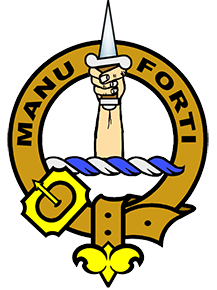
MacKay Clan
MacKay Clan Crest: An arm with the hand holding a dagger.
MacKay Clan Motto: Manu Forti (With a strong hand).
History of Clan MacKay:
Descent is claimed for the MacKays from the Royal House of Moray through the line of Morgund of Pluscarden. In 1263, Iye appears as Chamberlain to Walter, Bishop of Caithness, and by the 14th
century, the Clan was well established in Strathnaver. In 1415, Iye's descendant Angus Dubh married a granddaughter of Robert II. For the following four centuries, the MacKays were locked in a land struggle with
the Sutherlands, a feud they would eventually lose in 1829.
In 1627, Donald Mackay of Strathnaver, a supported of Charles I, became a Baronet of Nova Scotia, and in 1628 was created Lord Reay. Following the King's defeat, he went into exile in Denmark, where he died. The
2nd Lord Reay married, as his second wife, a daughter of General Hugh Mackay of Scourie who commanded the army of William of Orange at the Battle of Killiecrankie in 1689.
Aenas, second son of the 2nd
Lord Reay, was Brigadier General of Mackay's Scotch Regiment in Holland, where the family settled. In 1822, Barthold Mackay was created Baron Ophemert.
Meanwhile, the Chiefly line in Scotland continued until the 19th century when the 9th Baron Reay found himself heavily in debt, and, when he died unmarried in 1875, the Duke of Sutherland acquired his entire estate. Baron Ophemert in Holland thereupon became 10th Lord Reay, and Chief of the Clan.
Donald, 11th Baron Reay (1839-1921), was born in the Hague and became British Governor of Bombay and Under Secretary of State for India. On his death, the Reay title passed to a Dutch cousin whose father had been Prime Minister of Holland. The current Chief is his descendant,
Andrew MacKay (1760-1809) was Keeper of Aberdeen University Observatory. Mackintosh Mackay (1800-73) was oversaw the production of the Gaelic Dictionary for the Highland and Agricultural Society in 1828. Archibald Mackay (1801-83) wrote “My First Bawbee,” and “My Ain Couthy Wife.” Alexander MacKay (1833-1902) was President of the Educational Institute in Scotland. Alexander Murdoch Mackay (1849-90), born in Aberdeenshire, was a pioneer missionary in Uganda. Charles Mackay (1814 - 89) was a Scottish songwriter who composed such evergreens as “There's a Good time Coming,” and “Cheer Boys, Cheer!” James Mackay (1852-1932) founded the P&O Shipping Line and was created Earl of Inchcape in 1929. Donald Mackay (1927 - ), a professor of mathematics, served from 1987 to 1997 as Lord Chancellor of England under the title Lord Mackay of Clashfern.
Surname distribution in Scotland: The MacKay surname is widespread right across the width and breadth of Scotland. The highest populations can be found in the Western Isles (the main islands include Lewis and Harris, North Uist, South Uist, Benbecula and Barra), Aberdeenshire (includes all of the historic counties of Aberdeenshire and Kincardineshire with part of Banffshire), Moray (also includes a large area of historic Banffshire), Highland (including the historic counties of Caithness, Inverness-shire, Sutherland, Nairnshire and Ross and Cromarty), Aberdeen City, Angus (Forfarshire), Dundee City, Argyllshire and Renfrewshire.
Places of Interest: Eddrachillis, Sutherland. Lands held by MacKays between 1515 and 1757.
Dornoch, Sutherland. The Clan Feud between the Murrays of Dornoch and the Mackays of Strathnaver led to the town being plundered and burned in 1570.
Scourie, Sutherland. This estate was owned by the MacKays of Strathnaver, but sold to the Sutherlands and depopulated during the Highland Clearances.
Strathnaver Museum, Farr, near Bettyhill, Sutherland. Local history museum in a former church building.
Tongue House, Kyle of Tongue, Sutherland. I7th century seat of Lord Reay, but sold to the Duke of Sutherland.
Tuieam-Tarbhach (“Fertile plain of Slaughter”), near Inveran, Sutherland. A decisive victory was won here by the MacKays over the MacLeods of Assynt and Lewis.
Associated family names (Septs): Allan, Allanson, Bain, Bayne, Kay, Key, MacAllan, MacBain, MacCaa, MacCaw, MacCay, MacCrie, MacGaa, MacGaw, MacGee, MacGhee, MacGhie, MacKay, MacKee, Mackey, Mackie, MacPhail, MacQue, MacQuey, MacQuoid, MacVail, MacVain, MacVane, Morgan, Neilson, Nelson, Paul, Pole, Poleson, Pollard, Polson, Reay, Scobie, Williamson.
Clan MacKay display certificates.