
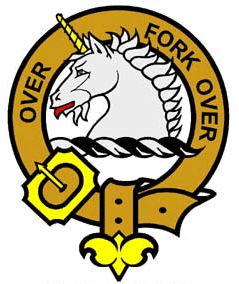
Cunningham Clan
Cunningham Clan Crest: A unicorn's head.
Cunningham Clan Motto: Over Fork Over.
Cunningham Clan History:
This surname is territorial and found in Ayrshire. The family, however, descends from Warnebald, a vassal of Hugh de Moreville, who appears to have settled here in the 12th century.
Around 1170, Robert filius de Warnebald granted land to the church of Kilmaurs, and a century later, Hervey de Cunningham, son of the laird of Kilmaurs, was with Alexander III at the Battle of Largs.
The Cunninghams were loyal supporters of Robert the Bruce and in 1319 were well rewarded. In the same century, Sir William Cunningham of Kilmaurs was one of the Scottish noblemen offered as an exchange hostage when David II was taken prisoner by the English in 1354. His son, also William Cunningham, married the daughter of Sir Robert Denniston of that Ilk and thereby the lands of Finlayston in Renfrewshire and Glen Cairn in Dumfriesshire came into the family. In 1462, James III created their grandson, Alexander Cunningham, Lord Kilmaurs, and in 1488, Earl of Glencairn. His younger brother was the ancestor of the Cunninghams of Caprington.
The 5th Earl of Glencairn was a staunch Protestant and friend of John Knox, who visited him at Finlayston. In 1657, he was one of the Scottish nobles who took the surrender of Mary Queen of Scots following the Battle of Carberry Hill.
The 9th Earl of Glencairn was loyal to Charles II and attempted to rally the Highland chiefs at Elgin. His insurrection against Oliver Cromwell, however, was a failure and he went into exile until the Restoration when he was appointed Lord Chancellor of Scotland. John, 14th Earl of Glencairn, along with his kinsman Sir William Cunningham of Robertland, was a prominent patron of Robert Burns, Scotland's National Bard. The title died out with the 14th Earl of Glencairn in 1796.
In the early 17th century, Sir James Cunningham, who was married to a daughter of the Earl of Glencairn, was granted 5000 acres of Donegal during the Ulster Plantation period, and, as a consequence, large numbers of the name are to be found today in Ireland. The title, Marquess of Conyngham, was created in the Peerage of Ireland in 1816.
Sir John Cunningham of Caprington was created a Nova Scotia baronet by Charles II in 1669.
Allan Cunningham (1784-1842) was born in Dumfriesshire and, at the age of 12, attended the funeral of his father's neighbour, Robert Burns. He himself became a poet and distinguished man of letters. William
Cunningham DD (1805-61) was born in Hamilton and in 1847 became Principal of the Free Church College. Sir Allan Gordon Cunningham (1887-1983) was a British General who freed Abyssinia and British Somaliland from
the Italians, and was High Commissioner to Palestine in 1945.
In 1796, Robert Graham, whose mother was a daughter of the 12th Earl of Glencairn, inherited the Glencairn estate and added the Cunningham surname to his own. He had returned from Jamaica where he had been a planter and
was elected a member of parliament from 1794-96.
His grandson was Robert Bontine Cunningham Graham (1852-1936) who, having been a rancher in the Argentine, succeeded to the family estates in 1883. He became a British member of parliament, but in 1887 was imprisoned
for calling an illegal assembly in Trafalgar Square.
In 1888, he was elected the first President of the Scottish Labour Party.
Places of Interest:
Maxwelton House, Moniaive, Dumfriesshire. Although famous from William Douglas's poem written in the 18th century, and the subsequent song about his love, Annie Laurie, part of the house dates back to 15th century
and was the stronghold of the earls of Glencairn.
Kerelaw Castle, Stevenston, Ayrshire belonged to the earls of Glencairn, but was sacked and left a ruin by the Montgomeries of Eglinton in the 15th century.
Kilmaurs, near Kilmarnock, Ayrshire. burgh of Barony for the earls of Glencairn.
Caprington Castle, near Kilmarnock, Ayrshire. Seat of the Cunninghams. The earliest parts of the castle date from the 15th century.
Finlaystone House, Langbank, Renfrewshire is currently the seat of Clan Macmillan,but was previously the seat of the earls of Glencairn from the 14th century.
Surname distribution in Scotland: The Cunningham surname is most commonly found in Fife, Stirlingshire, Falkirk, Clackmannanshire, Ayrshire, Lanarkshire and Edinburgh and the Lothians.
Buy a Clan Cunningham membership certificate.