
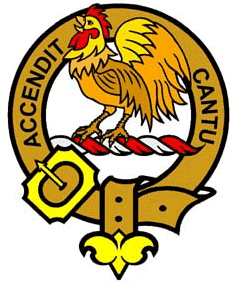
Cockburn Clan
Cockburn Clan Crest: A cock crowing.
Cockburn Clan Motto: Accendit Cantu (He excites us with song).
Cockburn Clan History:
The surname derives from a place name near Duns, in Berwickshire. However, there is also some debate over it having originated from the Scots word for cuckoo, there having been a 'Cuckoo Burn' or 'Gowk's Burn,' close to the Abbey of Melrose in Roxburghshire, with which the Cockburn family had an association. In 1250, John Kocbrun, a Fife landowner, ceded lands to the Monastery of Lindores. A Peter or Peres de Cokeburne rendered homage to Edward I of England in 1296, as did Thomas de Cokeburn of Roxburgshire.
Sir Alexander de Cockburn married the daughter of Sir William de Vipont who fell at the Battle of Bannockburn in 1314, and from him, the lands of Langton in Berwickshire passed to the Cockburn family. The Barony of Carriden was conferred by David II on Sir Alexander Cockburn de Langton, who in 1390 became Keeper of the Great Seal of Scotland.
Sir Alexander's son, also Sir Alexander, was created Hereditary Great Usher of Scotland. This office was later confirmed upon the Barony of Langton by King James IV, but was usurped by John, Earl of Wigtown. A committee of Parliament was appointed to resolve the matter, but Cockburn took matters into his own hands and protested his right when the King entered Parliament. He was arrested, but released the same day. His descendant, Sir William Cockburn of Langton, was killed at the Battle of Flodden in 1513.
The Cockburns were ardent supporters of Mary Queen of Scots, and, as a consequence, their castle at Skirling, in Midlothian, was demolished in 1568. The barony and estate of Langton was eventually sold to a cousin who received a Nova Scotia baronetcy in 1671.
Adam Cockburn of Ormiston in East Lothian (1656-1735), was Lord Justice Clerk and was created Lord Ormiston, His son, John Cockburn of Ormiston (d.1758) was an enlightened agricultural improver.
Lord Cockburn (1779-1854) was a Court of Session judge and a central figure of the Scottish Enlightenment. His uncle was the all-powerful Lord Melville. Lord Cockburn is best remembered today for his diary Memorials
of his Time (1856), and Journal (1831-44).
Alison Cockburn, nee Rutherford (1713-94) was a poetess and dominated the Edinburgh social scene. She wrote the lyrics for The
Flowers of the Forest.
Admiral Sir George Cockburn (1772-1853) escorted Napoleon Bonaparte into exile on the island of St Helena and became First Sea Lord.
Places of Interest:
Cockburnlaw, Duns, Berwickshire. A conical hill, North West of town.
Cockburnspath Tower, Cockburnspath, Berwickshire. Once a strong fortress and supposed to be the "Ravenswood" featured in Sir Walter Scott's Bride of Lammermoor.
Skirling, Peeblesshire. Held by Cockburn family until 1568.
Bonally Tower, Colinton, Edinburgh. This was the home of Lord Cockburn and today has been converted into apartments. Carriden, West Lothian. Barony conferred on Sir Alexander Cockburn by David II.
Surname distribution in Scotland: The Cockburn surname is most commonly found in The Scottish Borders (Berwickshire, Peeblesshire, Roxburghshire, Selkirkshire and part of Midlothian), Edinburgh City and the Lothians (Linlithgowshire, Edinburghshire, Haddingtonshire).
Buy a Clan Cockburn membership certificate.