
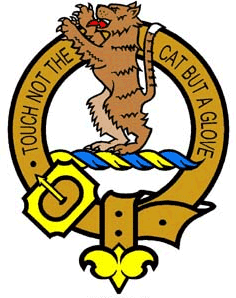
Chattan Clan
Chattan Clan Crest: A wildcat.
Chattan Motto: Touch not the cat but a glove (but meaning without).
Chattan Clan History:
The name of this tribal federation derives from Gilliechattan Mor, 'Great Servant of St Catan,' a member of the ancient Culdee Church who lived on the island of Bute. By the 12th century, descendants and followers of the
Saint had spread to Glenloy and Loch Arkcaig in Lochaber.
In 1291, Eva, daughter of Gilpatrick, the Clan Chattan Chief, married Angus, Chief of Clan Mackintosh, and to begin with they set up home at Torcastle in Glenloy. Having incurred the enmity of Angus Og of
Islay, who had acquired the Macdougall lands of Lorne, they were compelled to flee from Lochaber for safety and settled in Rothiemurchus, whereupon the Camerons seized their lands in their absence. This led to a long
and bitter feud between the two clans which lasted for almost three hundred years.
The Mackintoshes had previously been established in Rothiemurchus and, in time, formed defensive alliances with other clans in the region " the Farquharsons of Invercauld, Shaws of Tordarroch and MacThomases of Finegand.
They were soon joined by the MacBains of Kinchyle, Cattanachs, MacPhails, Macleans of Dochgarroch, Gows, Clarks, MacQueens of Pollochaig, MacIntyres of Badenoch. MacAndrews and MacGillivrays of Dunmaglass.
For almost five centuries, the territory under the protection of Clan Chattan stretched from Laggan in Inverness-shire to the Upper Spey Valley. To consolidate the position, a gathering was held in 1608 at
which the leaders of the various families confirmed their allegiance to the 17th Chief of Mackintosh.
Clan Chattan supported the Stuarts and the Jacobite Cause during the uprisings of 1715 and 1745. When Prince Charles Edward Stuart arrived in Scotland to promote his father's claim to the British throne in 1745, the Mackintosh chief was an officer in the Black Watch which supported the Government, but in his absence, his wife Anne, a daughter of Farquharson of Invercauld, called out Clan Chattan.
The aftermath of the defeat of the Jacobite army at Culloden radically changed the nature of the Highlands of Scotland, and Clan Chattan took heavy losses. One of the main consequences was that clans which had hitherto been members of the Confederacy broke away to follow their own destinies.
Places of Interest:
Rothiemurchus Old Church, near Aviemore, Badenoch and Strathspey. The Grave of Shaw M"r, traditional leader of thirty Clan Chattan champions at Perth.
Ardchattan Priory, Loch Etive, Argyll. This was consecrated in honour of Gilliechattan M"r.
North Inch, Perth. Clan Battle fought between thirty champions of Clan Chattan (Mackintosh) and thirty champions of Clan Cameron, 1396.
Clans, septs and families associated with the Chattan Confederation: Cameron, Cattanach, Clark, Davidson, Farquharson, Gillespie, Gow, Keith, MacAndrews, MacBain, MacBean, MacGillivray, MacGlashan, MacHardie, MacIntosh, MacIntyre of Badenoch, MacKintosh, MacLean of Dochgarroch, MacPherson, MacQueen, MacTavish, MacPhail, Noble, Shaw, Smith.