
Charteris Clan
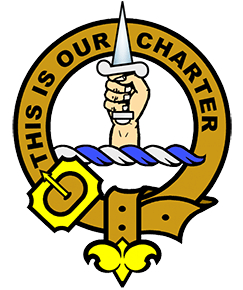
Charteris Clan Crest: An hand holding a dagger.
Charteris Motto: This Is Our Charter.
Charteris Clan History:
The family is said to have originated in the French town of Chartres, and to have come to England with William the Conqueror in 1066. Sir Thomas de Charteris. Lord Chancellor of Scotland, had the wardship of Amysfield in Nithsdale, Dumfriesshire granted to him following the death of Alexander III in 1286. Robert de Chartres and William de Chartres of Roxburghshire rendered homage to Edward I of England in 1296. A son and grandson of the Lord of Chartres are thought to have accompanied David I when he returned to Scotland from the English Court of his brother-in-law, Henry I.
The Latinised version of the name is de Carnoto, and in the reign of William the Lion we find the church of Dungrey being gifted to the Abbey of Kelso by Walter de Carnoto.
William de Charteris was a contemporary of Robert the Bruce and was with him in 1306 when the Red Comyn was murdered in Dumfries. Sir Thomas Charteris of Amisfield was appointed Lord Chancellor by David II, but was killed at the Battle of Durham in 1346.
In 1530, a dual was fought between Sir Robert Charteris of Amisfield and Sir James Douglas of Drumlanrig in the form of a mediaeval tournament staged before James V. The contest was enacted with such ferocity that Charteris's sword was broken and the King had to intercede to separate the combatants.
!n the 17th century, Sir John Charteris of Amisfield supported the National Covenant, but refused to take up arms against the Crown. He and his brother fought with the Marquis of Montrose and were at the Battle of Philiphaugh in 1645.
Charteris lands then passed through an heiress to Thomas Hogg, who took the name of Charteris. Colonel Francis Charteris purchased land at Haddington which he re-named Amisfield. His daughter Janet married the 4th Earl of Wemyss, a Commissioner for the Act of Union in 1707. Their second son, who became 5th Earl of Wemyss, his brother, Lord Elcho, having been attainted for his part in the 1745 Jacobite Uprising, inherited the estates of his maternal grandfather. In so doing, he assumed the name and arms of Charteris of Amisfield.
Meanwhile, the Wemyss estates in the Kingdom of Fife and arms devolved to the 3rd son of the 5th Earl of Wemyss as James Wemyss of Wemyss. Through marriage with the Douglas family, the Charteris earls of Wemyss thereafter acquired the earldom of March, and lands in Peeblesshire, including Neidpath Castle on the banks of the River Tweed, a former stronghold of Clan Hay.
Archibald Hamilton Charteris (1835-1908) was Professor of Biblical Criticism at Edinburgh. He founded the Church of Scotland Women's Guild and first published the periodical Life and Work.
Places of Interest:
Amisfield, Dumfriesshire. Five miles north east of Dumfries. The tower here dates from 1600.
Gosford House, Aberlady, East Lothian. Partly designed by the architect Robert Adam, this is today the seat of the earls of Wemyss & March. Amisfield House, by Haddington, was demolished in 1928 and the park turned into a golf course.
Neidpath Castle, near Peebles, Peeblesshire Owned by Wemyss Estates and open to the public April to October.
Surname distribution in Scotland: The Carnegie surname is most commonly found in Renfrewshire and Argyll and Bute.