
Carmichael Clan
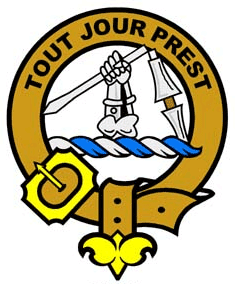
Carmichael Clan Crest: An armed hand holding a broken spear.
Carmichael Motto: Tout Jour Prest (Always Ready).
Carmichael Clan History:
The surname originates from a Barony found in Lanarkshire, territory granted to the Douglas Family by Robert the Bruce in 1321. Prior to this, c.1221, Robert de Carmitely had right of Lordship in the land of Cleghorn, and Willian de Creimechel witnessed a charter in 1225. Between 1374 and 1384, Sir John de Carmychell held a charter for the lands of Carmychell from William, Earl of Douglas. The Barony of Carmichael was confirmed on the head of the family in 1414.
Sir John de Carmichael of Meadowflat fought with the Scottish mercenaries sent to France to help the French army against the English invasion of Henry V. At the Battle of Baugé he is said to have broken his spear while toppling the unfortunate Duke of Clarence from his horse, an action which led to the Duke being killed by Sir Alexander Buchan. Thereafter the English became so demoralised that they fled from the battlefield.
In recognition of the services rendered to France by the Scots, John Carmichael became Bishop of Orleans. He is known in French history as Jean de St Michel and in 1429 founded a Messe
"cossais in his Cathedral in memory of his countrymen slain at the Battle of Verneuil in 1424.
In the following century, Catherine, daughter of Sir John Carmichael of Meadowflat became mistress to James V, bearing him a son who was a half-brother to Mary, Queen of Scots.
In 1546, Peter Carmichael of Balmedie was among the four conspirators held responsible for the killing of Cardinal Beaton in St Andrews.
Sir John Carmichael was knighted by James VI at the Coronation of Queen Anne, became Captain of the King's Guard and Warden of the West Marches, and was later shot during a skirmish with Armstrong renegades in Dumfriesshire.
Sir James, 1st Lord Carmichael was raised to the peerage in 1647. His son married the daughter of the Marquis of Douglas. In 1701, their son, a supporter of Charles I, was created Earl of Hyndeford.
Loyalty to the Crown, however, wavered, and the 2nd Earl sided with the Parliament forces under Oliver Cromwell. He commanded the Clydesdale Regiment at the Battle of Marsden Moor in 1644, and the following year
defeated the Marquis of Montrose at Philiphaugh. The 3rd Earl, however, supported the Hanoverians.
In Galloway and the South West, some Carmichaels adopted the name of MacMichael and at the Battle of Culloden in 1746, the Carmichaels (Macmichaels) were the largest group of fatalities fighting for the Stewarts of Appin. The southern Carmichaels, who fought for the Duke of Cumberland, suffered an equal number of casualties.
In 1817, the 6th Earl of Hyndeford died unmarried and the family title and honours became dormant, the lands devolving through the female line to Sir John Anstruther of Anstruther, Bt, his claim deriving from his descent from a daughter of the 2nd Earl. The property remained with the Carmichael-Anstruther family until the death of Sir Wyndham Carmichael-Anstruther in 1980, whereupon the Chiefship devolved on Richard Carmichael of Carmichael, who was living at the time in New Zealand.
The 30th Chief returned to live in Scotland with his family, and two hundred Carmichaels attended the Carmichael Re-union in 1983. The most recent clan gathering took place at Carmichael in 2000, and the Carmichael Clan Society is active worldwide.
Places of Interest:
Carmichael Estate Visitor Centre, near Biggar, Lanarkshire. Clan Information and Tea Room. Sixteen self-catering cottages are available to let on the estate. The Carmichael farmlands produce traditional meat products
including venison, beef and lamb and the Carmichael Chief is a regular stall holder at the weekly farmers' markets held throughout Scotland.
Fenton Tower, East Lothian.
Patrick Whytelaw, son of Lord Ruthven, constructed the current building around 1550, a typical fortified tower of the time. But in 1587, ownership of the tower was forfeited to Sir John Carmichael, a reward for his having been the Scottish Ambassador to Denmark. Fenton Tower has now been completely restored and provides luxury to let accommodation for up to twelve people.
Surname distribution within Scotland: The Carmichael surname is most commonly found in Glasgow, Dunbartonshire, Lewis in the Outer Hebrides, Renfrewshire, Argyll and Bute, Perth and Kinross (Perthshire and Kinross-shire) and Dumfries and Galloway (Dumfriesshire, Kirkcudbrightshire and Wigtownshire).
Clan Carmichael membership certificates.