
Buchanan Clan
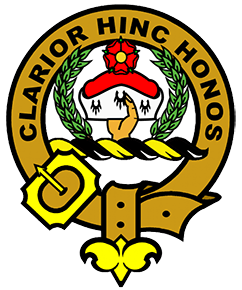
Buchanan Crest: A hand holding aloft a ducal cap within laurel branches.
Buchanan Clan Motto: Clarior Hinc Honos, (Brighter hence the honour).
Buchanan Clan History:
"Buth Chanain." in Gaelic, means "House of the Canon." The origins of this clan are in Stirlingshire, and the Buchanan clan lands, were on the eastern shores and lower end of Loch Lomond. A clan tradition
has it that they were acquired in the 11th century through marriage by one Anselan O'Kyan, a son of the King of Ulster, who supported Malcolm II in repelling a Danish invasion. Two centuries later, the territory was
granted to Dominus Absalon, said to have been a Holy man, by the earls of Lennox c.1225. In the same century, a charter from Alexander II confirms the clan's ownership of the island of Clairinch, then known as
"Slughorn" after the clan's war cry.
The family of Buchquhanne was formally recognised by David II in the 14th century, whereupon a number of cadet branches sprang up " Arnprior, Auchamar, Carbeth, Drumikill, Leny and Spittal. In the 14th century, they supported the cause of Robert the Bruce and benefited significantly as a result.
Sir Alexander Buchanan fought alongside other Scottish mercenaries with the French army against the forces of Henry V of England. He is said to have killed the Duke of Clarence at the Battle of Baug" in 1421, hence the ducal coronet which appears on the family crest. Sir Walter Buchanan married the daughter of Murdoch Stewart, Duke of Albany and Governor of Scotland in the absence of James I. The latter was beheaded for treason in 1425 which left his immediate relatives somewhat in disarray. The Chief of the Buchannan's and many of his followers died at the Battle of Flodden in 1513.
The Buchanan's of Arnprior held lands at Kippen in Perthshire, but the head of the family was killed at the Battle of Pinkie in 1547. The chiefly clan lands were to have passed to this branch with the death in 1681 of John Buchanan of that Ilk, 22nd Laird, leaving two daughters. Unfortunately, he also left substantial debts and his estate had to be sold to meet massive death duties. It was purchased by the 3rd Marquis of Montrose, Chief of Clan Graham.
Clan Buchanan was largely dispersed thereafter. The Buchanan Clan Society was registered in Glasgow in 1725, ten years after the first Jacobite Uprising and twenty years before the second. It is therefore the oldest Clan Society in the world. The last Clan chief, John Buchanan, died without issue in 1681 and the dignity remained dormant for 337 years. In 2018, the Lord Lyon King of Arms formally recognised John Michael Baillie-Hamilton Buchanan (The Buchanan) as the first new chief of the Clan Buchanan in 337 years.
George Buchanan (1506 - 82) was third son of Buchanan of Drumikill. He was appointed tutor to Mary Queen of Scots in 1536, and later to her son James VI, who later became James I of England. An enlightened teacher, Buchanan is largely credited for King James's considerable academic skills.
James Buchanan (1791- 1861), son of Scottish/Irish immigrants, was born in a log cabin in Pennsylvania. He became the 15th President of the United States of America
Places of Interest:
Clairinch, Loch Lomond, Stirlingshire. Island nature reserve owned by Buchanan Society and managed by Scottish National Heritage.
Buchanan Castle, west of Drymen, in Stirlingshire, was built by the 4th Duke of Montrose after the original house was destroyed by fire in 1852. In 1955 the roof was removed to avoid payment of death duties.
Today is it a substantial ruin.
Moss, Strathblane. Stirlingshire. Birthplace of George Buchanan (1506-82), tutor to James VI & I.
Ardoch, Strathyre. Stirlingshire. Birthplace of Dugald Buchanan (1716-65). Gaelic poet and evangelist.
Associated family names (Septs): Colman, Cormack, Cousland, Dewar, Dove, Dow, Gibb, Gibbon, Gibson, Gilbert, Gilbertson, Harper, Harperson, Leavy, Lennie, Lenny, MacAldonich, MacAlman, MacAslan, MacAlsin, MacAusland, MacAuslane, MacCalman, MacCalmont, MacCammond, MacCasland, MacChruiter, MacColman, MacCormack, MacCubbin, MacCubing, MacCubin, MacGeorge, MacGibbon, MacGreusich, MacGubbin, MacInally, MacIndeor, MacIndoe, MacKinlay, MacKinley, MacMaster, MacMaurice, MacMurchie, MacMurchy, MacNeur, MacNuyer, MacQuattie, MacWattie, MacWhirter, Masters, Masterton, Morrice, Morris, Morrison, Murchie, Murchison, Murchison, Richardson, Risk, Rusk, Ruskin, Spittal, Spittel, Walter, Walters, Wason, Waters, Watson, Watt, Watters, Weir, Yuill, Yool, Yule, Zuil.
Surname distribution in Scotland: The Buchanan name is most commonly found in Stirlingshire, Falkirk, Clackmannanshire, Renfrewshire, the Outer Hebrides, Argyll and Bute and the Southern Inner Hebrides.
Clan Buchanan membership prints.