
Boyd Clan
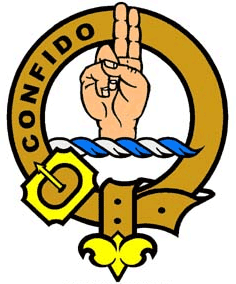
Boyd Crest: A dexter hand erect with the last two fingers bowed inwards.
Boyd Clan Motto: Confido (I Trust).
Boyd Clan History: The Boyd surname is almost certainly Norman, though it has been suggested in the past by some historians that the name has Celtic origins.
The first Boyd's in Scotland were vassals of the Norman family De Morevilles, in the regality of Largs, and it's most probable they came north in their train from England.
The Boyd surname is first recorded in 1205 when Dominus Robertus de Boyd, a nephew of Walter the first High Steward of Scotland, witnessed a contract between Bryce de Egluntune and burgh of Irvine.
Robert Dictus Boyd, son of Robertus, is mentioned in a charter by Sir John Erskine of the lands of Halkhill in 1262. In 1263 Robert is said to have distinguished himself against King Haakon's Viking forces at the greatly exaggerated Battle of Largs.
Robert de Boyt is mentioned in the Ragman Roll of 1296, rendering homage to Edward the first. As Sir Robert de Boyt he was taken prisoner in 1306. Duncan Boyd was hanged by the English in the same year for aiding Robert the Bruce in the wars of Independence.
Sir Robert Boyd commanded the right wing at the Battle of Bannockburn in 1314.
In a Royal charter of 1316 Robert the Bruce granted Boyd the former Balliol lands of Bondington, Hertschaw along with the Barony of Kilmarnock.
Sir Robert died after being taken prisoner by the English at the battle of Halidon Hill in 1333. Robert's son, Alan Boyd, was killed at the Siege of Perth, 1339, whilst in command of the Scottish Archery.
Sir Thomas Boyd, another son of Robert's, was captured and imprisoned along with King David II and other Scottish nobility after the disastrous battle of Neville's Cross in 1346. His eldest son, also Sir Thomas, had a remission from Robert Stewart, Duke of Albany, Governor of Scotland, in 1409, for the slaying of Neilson of Dalrymple.
Robert Boyd was created "Lord Boyd of Kilmarnock" by James II in 1454. Upon the death of James II, at the siege of Roxburgh castle, when a cannon accidentally exploded, Lord Boyd was appointed as a regent for the infant King James III.
Lord Boyd also held the office of Great Chamberlain between 1466 and 1469, his brother, Sir Alexander Boyd of Drumcol, was appointed as instructor of knightly exercises to the young King, and Robert's son, Thomas Boyd, married the Kings sister, Mary and received the title "Earl of Arran".
In 1469 Thomas arranged the marriage of the eighteen year old king and the ten year old Margaret, princess of Denmark and Norway. The Orkney and Shetland Islands passed to Scotland as part of the dowry.
The Boyd's had truly become one of the most powerful and influential families in all of Scotland. The rise to power also made them some powerful and envious enemies amongst the Scottish nobility.
As James III grew older the Boyd's enemies conspired against them, eventually persuading the young King that the Boyd's ambitions lay with the throne of Scotland itself. In 1469 all three were summoned to appear before the King and parliament in Edinburgh on charges of treason. Alexander answered the charges, was found guilty and beheaded. Robert fled to England and was sentenced to death in his absence, his peerage and lands were forfeited, Thomas who was in Europe at the time of the summons, stayed in exile. His marriage to the Kings sister was annulled by James III.
The only son of Thomas, James, was briefly the second Lord Boyd, and many of the Boyd's lands, including the Barony of Kilmarnock were restored to him. Two years later, at the age of 16, he was killed by Hugh Montgomery
of Eglinton, and the Boyd lands again passed to the state.
A great grandson of the first Lord Boyd, Robert, was appointed the forth Lord Boyd, by Mary Queen of Scots, and the former lands of the Boyd family were restored. He is said to have killed several of the Montgomery family
in the ongoing feud between the families which lasted over 70 years. He fought for the Catholic army of Queen Mary at the battle of Langside.
William Boyd, the tenth Lord supported the king during the civil war, and after the restoration, was created the first Earl of Kilmarnock in 1661. His son, William, third Earl of Kilmarnock, supported the treaty of the Union, raising 500 men in opposition to the Jacobite rebellion of 1715.
William Boyd, 4th Earl of Kilmarnock, supported the Jacobite cause. A general at Culloden, William was taken prisoner, and beheaded at the tower of London in 1746. The Boyd estates were forfeited. William's son, James, succeeded in 1758 to 15th Earl of Erroll. James took the name of Hay and moved to Slains castle in North East Scotland.
Places of Interest: Bedlay Castle, nr. Chryston, Lanarkshire. 16th century tower house owned by the Boyds of Kilmarnock since the reformation. The castle was sold by the Boyds in 1642 to pay a £15000.00 fine imposed by Oliver Cromwell for their royalist sympathies. Brodick Castle, Brodick, Isle of Arran. Magnificent castle and estate overlooking Brodick bay and surrounded by mountains. Held by the Boyds from 1467 until 1503, when it it passed to the Hamiltons. Callender House, Falkirk, Stirlingshire. Grand mansion house which incorporates a 15th century castle. One of the main residences of by William Boyd, 4th Earl of Kilmarnock, and his wife, Lady Anne Livingston. Boyd was taken prisoner after the Battle of Culloden and beheaded in 1746 for his role in the Jacobite rebellion. Cherrytrees, nr. Kelso, Borders. Classical mansion house, built on the site of an earlier castle, overlooking the Cheviot hills. Owned by the Boyds during the 19th century. Dean Castle, formerly known as Kilmarnock Castle, was built by the Boyds around the mid 1300's and continued as their main seat for the next 400 years. The defensive keep had three meter thick walls and no doors or windows on the ground floor. Access to the keep was by a ladder to the first floor entrance. A Great Hall, with a high vaulted stone ceiling and a minstrels gallery lay within. In event of attack, the castle had battlements for crossbow men and archers. In the guardroom a hatch leads down the dungeon. The upper floor with its own hall, living quarters, and chapel, were for the use of Lord Boyd and his family. A palace was added at the height of the Boyd's prosperity in the 1460's. Although the palace was built for comfortable living, defence was still a major consideration. The palace courtyard was protected by a large barmkin and a tower with battlements defended the palace. The ground floor of the palace housed the kitchen with a large oven and fireplace. The first floor had a large banqueting hall. The living quarters and bedrooms for the Lord and his family were on the second floor. An accidental fire at the palace in 1735 left it in ruins for the next 200 years. Restored in the first half of the 20th century, the palace is now a museum housing an impressive collection of arms, armour, medieval tapestries and musical instruments. Kerelaw Castle, Stevenston, Ayrshire. Ruined medieval castle, bought by the Boyds in 1609 and held briefly for a few years before being sold to the Cunninghams. Kipps, Torphichen, Lothians. Ruined tower house, built by the Boyds in the 1500's and held by the family for over two centuries before passing to the Sibbalds. Law Castle, West Kilbride, Ayrshire. 15th century tower overlooking the Firth of Clyde. Built in 1468 for Princess Mary, daughter of James II, on her marriage to Thomas Boyd, later to become the Earl of Arran. Penkhill Castle, nr. Girvan, Ayrshire. 16th century tower house with later additions. Property of the Boyds from the early 1500's until 1978. Portencross Castle, Portencross, nr. West Kilbride, Ayrshire. Constructed in the mid 1300's, on lands that Robert the Bruce granted to the Boyds of Kilmarnock, after the wars of independence. Held by the Boyds until 1785.
Surname distribution: The Boyd surname is most commonly found in Ayrshire, Lanarkshire, Renfrewshire, Argyll and Bute and Dumfries and Galloway (Dumfriesshire, Kirkcudbrightshire and Wigtownshire).