
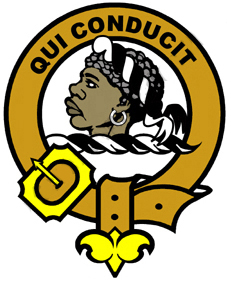
Borthwick Clan
Borthwick Crest: A moor's head, couped, proper.
Borthwick Clan Motto: Qui Conducit (He who leads).
Borthwick Clan History:
Andreas Borthwick is recorded as having accompanied Edgar the Atheling, claimant to the English throne, and his sister Princess Margaret Atheling, from England to Scotland in 1068. Princess Margaret later married the Scottish king Malcolm Canmore.
Since the Athelings represented the ancient Saxon Royal Family, and were connected with the rulers of Hungary, it is thought that Andreas was of Hungarian descent. However, the surname has a territorial origin, originating from the Borthwick Water in Roxburghshire. The Borthwick family is one of the oldest on record in Scotland and has consistently played a prominent role in national affairs.
Thomas de Borthwick had a Charter for lands near Lauder from John of Gordon in 1357. In 1378, William de Borthwick owned the lands of "Catcune" in Midlothian which he re-named Borthwick. Around 1410, he received a Charter for these lands.
The first Lord Borthwick was sent to England in 1425 as a hostage for the return of James I. It was he who built Borthwick Castle, near Middleton in Midlothian, and this formidable fortress is today leased from his descendants and run as a hotel and wedding venue.
The early sequence of the lords Borthwick is confusing in that for six generations they shared the same Christian name of William. The 3rd Lord Borthwick is said to have fought and died at the Battle of Flodden in 1513. The 4th Lord Borthwick, a close confidant of Queen Mary de Guise, was appointed a guardian of the infant James V and given the command of Stirling Castle. The 5th Lord Borthwick was a loyal supporter of Mary, Queen of Scots, and it was at Borthwick Castle that she and her third husband, James Hepburn, 4th Earl of Bothwell, took refuge after their marriage, but were forced to flee when Mary's half-brother, the Earl of Moray arrived with a large force.
The Borthwicks supported the Royalist Cause during the Civil War, and Borthwick Castle was besieged following the Battle of Dunbar in 1650. The castle was spared when Oliver Cromwell negotiated its surrender. The 9th Lord Borthwick died in 1675, and thereafter, the direct line came to an abrupt halt, and was only revived a century later when Henry Borthwick of Neathorn was recognised by the House of Lords as a direct descendant of the first Lord Borthwick. However, he died without issue, and for eight generations over two centuries, the title was disputed by various branches of the Borthwick family despite it being reinstated for the 14th Lord Borthwick, in 1762, and for the 19th Lord Borthwick, in 1870,
In 1986, Major John Henry Stuart Borthwick of Crookston, Midlothian, was recognised as 23rd Lord Borthwick by the Court of the Lord Lyon King of Arms. The last holder of the de jure 15th
Century title died in 1910, and it was only in the late 1940s when Vatican records concerning Scotland became available and Scottish records were more comprehensively catalogued, that Major Borthwick was able to
establish his claim. The Chiefship is today held by his son John, 24th Lord Borthwick.
James IV's Master Gunner was Robert Borthwick who built seven great canons called the "Seven Sisters". They were put to use at the Battle of Flodden in 1513, but as history relates the guns were facing in the opposite direction from the English attack. Sir John Borthwick (d.1560) was condemned to death for heresy and, having fled to England, was burned in effigy. He served Henry VIII of England on various missions and returned to Scotland in 1561 when his sentence was revoked. David Borthwick of Lochhill was Lord Advocate of Scotland in the reign of James VI. Kenneth Borthwick was Lord Provost of Edinburgh from 1977 to 1980.
Places of Interest: Borthwick Castle, North Middleton, Gorebridge, Midlothian. One of the most impressive and best-preserved medieval castles in Scotland. Owned by the Borthwicks from 1430, until the death of the 9th Lord Borthwick, in the late 17th century. Bought back by the Borthwicks of Crookston in the early 1800's and now run as a luxury hotel and wedding venue. Crookston Old House, Heriot, Midlothian. 17th century Lairds house which incorporates a 15th century tower. Built by the Borthwicks in the mid-1400's. The Borthwicks still own Crookston House, a 19th century replacement mansion, built nearby in the 19th century. Greenlaw House, nr. Penicuik, Midlothian. Held by the Borthwicks from the mid 1500's until the late 1700's. Remodelled into a prison and barracks in the 1800's. Nenthorn House, nr Kelso, Borders. Jacobean mansion house which incorporates parts of an earlier tower house. Held by the Borthwicks from the early 1500's until the late 1700's. Newbyres Castle, Gorebridge, Midlothian. Not much remains of this 16th century tower house which was built by the Borthwicks in the mid-1500s. Pilmuir House, nr Haddington, Lothian. 17th century lairds house, passed by marriage to the Borthwicks in the mid-1600's. Ravenstone Castle, nr. Whithorn, Wigtownshire. 16th century tower house which was owned by Lord Borthwick in the 19th century. Stow, nr. Lauder, Borders. Ruined 15th century bishops palace, held by the Borthwicks during the 17th century.
Surname distribution: The Borthwick surname is most commonly found in The Scottish Borders (Berwickshire, Peeblesshire, Roxburghshire, Selkirkshire and part of Midlothian), Edinburgh and the Lothians, and Dumfries and Galloway (Dumfriesshire, Kirkcudbrightshire and Wigtownshire).
Clan Borthwick membership certificates.