
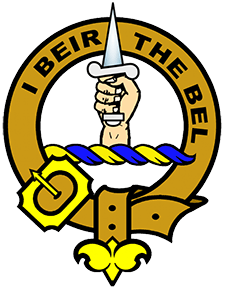
Bell Clan
Bell Crest: A hand holding a dagger, paleways proper.
Bell Clan Motto: I Beir the Bel.
Bell Clan History:
A Border riding Clan which gave allegiance to the House of Douglas until the power of that great Clan was dispersed. It is thought that the Bells originate from a Norman supporter of David I, and that the name comes from the French word "Bel", translated as meaning beautiful or handsome.
For generations, the Bells were settled in Middlebie, Dumfriesshire and Berwickshire, although a family of the name was also connected with the church of Dunkeld in Perthshire, an Andrew Bell and Thomas dictus Bell being Canons, and a William Bell serving as Dean.
William Bell, Vicar of Lamberton, witnessed a Charter to Coldingham Priory in 1271, and Adam and Richard Belle rendered homage to Edward I of England in 1296. For generations, the Borders-based Bells survived along with their neighbours through cattle reiving on the West Marches. Their tower at Blackethouse in Dumfriesshire was destroyed in an English raid of 1547, and, after the Union of the Crowns in 1603, they were declared "unruly" by the Scottish Parliament. Many of the Clan moved to the Ulster Plantations, where the name is still widely held. Others emigrated to Australia and New Zealand. Several also crossed the Border into England and settled in Northumberland.
After the Chief of the Clan, William Bell, called "Redcloak" after the captured cloak of an adversary seized in battle, died in 1628, the Chiefship became dormant. Dispersed and without leadership, the Bells ceased to exist as a viable Clan. However, in 1990, a petition was begun in support of Douglas Bell, CBE, but he unfortunately died in 1993 before the process of submission to the Lord Lyon King of Arms was completed. In the meantime, his son Benjamin is recognised as Chief Apparent by Clan Bell International (CBI), a charitable non-profit making organisation based in the USA.
Since 1984, the Bells have had two tartans: "Bell of the Borders", informally known as "Dress Blue", and "Bell South", the latter celebrating the merger of Clan Bell International and Clan Bell Descendants.
Andrew Bell (1753-1832, was born at St Andrews and went to Madras in India, where he developed the pupil-teacher system of education. Henry Bell (1767-1830) designed the "Comet", the first vessel to be propelled by steam on a navigable river in Europe. It was built at Port Glasgow in 1812. Sir Charles Bell (1774-1842), was born in Edinburgh and pioneered work on the human nervous system. He became Professor of Anatomical Surgery at the Royal College of Surgeons in London in 1824, Principal of the Medical School at University College, London, in 1828, and Professor of Surgery at Edinburgh in 1836. The Reverend Patrick Bell (1799-1869) was born at Auchterhouse and became the Minister at Carmylie, Angus. He invented the reaping machine. Alexander Graham Bell (1846-1922) was born in Edinburgh and his parents, having emigrated to America, became Professor of Vocal Physiology at Boston University, USA. In 1876, he invented the telephone. John Jay Bell (1871-1934) was a humourist writer of such works as Wee MacGreegor and Mistress M'Leerie.
Places of Interest: Blacket House Tower, Eaglesfield, Dumfriesshire. Ruined tower house, which sits in the grounds of the 19th century Blacket House mansion, was a property of the Bell Chiefs from the 15th century until the 18th century. The tower was sacked in an English raid in 1547 and burned out in the mid-1600's. Rammerscales House, nr. Lockerbie, Dumfriesshire. 18th century mansion house, bought by James Bell of Glasgow in the late 1700's and still owned by his descendants, the Bell MacDonald family. Bell's Brae, in the Dean Village of Edinburgh, was named after Walter Bell, a miller here. Bell's Wynd, in the old Town of Edinburgh, was named after John Bell's brewery, to which it led in the 16th century.
Surname distribution within Scotland: Most instances of the Bell surname occur in the Scottish Borders (Berwickshire, Peeblesshire, Roxburghshire, Selkirkshire and part of Midlothian) and Dumfries and Galloway (Dumfriesshire, Kirkcudbrightshire and Wigtownshire).